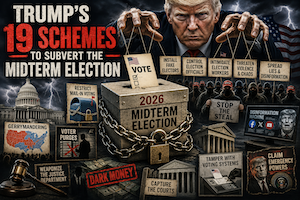
Justin Glawe discusses his recent American Doom columns for Zeteo in their ‘Start The Steal’ series, covering the many actions Trump and his regime have launched to interfere with and manipulate the outcome of this November’s midterm election.
SCOTT HARRIS: Right now, I’m very happy to welcome back to our program, our friend Justin Glawe, an independent journalist and editor of the American Doom newsletter and author of the new book, If I’m Coming to Your Town, Something Terrible Has Happened: The Life and Times of a Domestic War Correspondent. Justin, thank you for making time to be on our program again tonight.
JUSTIN GLAWE: Happy to be here. Thanks.
SCOTT HARRIS: It’s good to talk with you again, and I want to congratulate you on the new book. And before we get to our topic this evening, Trump threats to the midterm election, briefly talk about the issues examined in the new book, and I’d love to have you back to talk about that specifically at some future date.
JUSTIN GLAWE: Sure. Yeah, thanks. Yeah, the book is the product of the last 15 years of my life as a reporter and covering all of the madness and chaos that’s happened in that time period, and just sort of an examination of what American life has looked like, to me at least, it’s felt like there’s been a visible sort of decline in terms of violence and polarization, and also some good stuff in there too though. So there’s a lot for people who want to be hopeful as well as realistic, I guess.
SCOTT HARRIS: Thanks for that, Justin. So in a series of articles you’ve written on your American Doom newsletter and on the Zeteo website with Asawin Suebsaeng, you investigate Donald Trump and his administration’s attempt to subvert and manipulate the outcome of this November’s midterm election where control of Congress, the House and Senate is at stake. And you’ve written a lot of detail here, and I have to say in this last 18 months, I’ve made an effort to really follow some of the more important issues about the election subversion project we see coming out of the White House. And it’s difficult because there’s something new almost every day, and it’s that kind of philosophy we see coming out of the White House is that throw everything everywhere all the time, and it’s confusing and it feels overwhelming. But maybe you can give us an overview of the things that you have documented and will continue to document leading up to the November election.
JUSTIN GLAWE: Sure. Yeah. I think the biggest probable threat is the seizure of ballots post-election or even on election night in November. Trump wanted to do this back in 2020. He said in December that he wished he had done it in 2020. He was talking about voting machines, but it’s sort of the broader principle of the seizure of election equipment and records. And of course, in January, the FBI raided the Fulton County (Georgia) elections warehouse and took ballots from 2020. Of course, that’s a far different scenario than seizing ballots in an ongoing election, but I think that’s probably the highest potential threat because if they seize the ballots prior to certification, well, how do you certify an election that you can’t tally the votes for? In addition to that, there’s lots of people who—the phrase “national emergency” has been thrown around a lot. People are worried about ICE or National Guard at the polls.
To me, that’s an important thing to be concerned about, but that’s kind of more of an intimidation tactic, whereas the seizure of ballots really affects the outcome of the election in a much more concrete way.
SCOTT HARRIS: Yeah and there’s so many details here, and I’ll just mention your article earlier this month titled, “Here are 19—Yes, 19—Ways Trump and Republicans are Plotting to Rig and Steal the Midterm Elections.” You go into detail of these 19 strategies and tactics Trump has launched to change the outcome of the midterm election. I wondered if you discussed some of the most alarming schemes and those flying below the radar—the media radar—beyond the ones you just mentioned here. What are some of the ones that maybe our listeners haven’t heard about? Because as I said, these 19, you go into a lot of depth.
JUSTIN GLAWE: Yeah, there’s a lot there. As far as ones that are kind of under the radar, I think that this isn’t in the list of the 19, but there is this House challenge to elections scenario that can occur post-certification that I think is an important one to pay attention to, which is the House can challenge the qualifications of really its own members. As far as stuff that’s in “the 19 list,” I think that the one that people are really paying attention to is National Guard and ICE, troops at the polls. I’m having trouble, honestly, remembering all of them right now because there’s so many of them. And the joke was when we were writing it, whenever we though we’d completed the list, we had thought of one more. But let’s not also discount the issue of local certification of election results, which isn’t necessarily Trump from on high doing that, but it’s people who are in line with his sort of election denial mentality that could potentially gum up the works a little bit in terms of certification.
I think also another thing to pay attention to is voter purges. That’s one of the 19. And the reason that’s important is because the RNC is currently asking the Supreme Court to basically allow them to challenge the eligibility of a ton of voters in Arizona in particular. But if they get their way with the Supreme Court, they’ll challenge a lot of voters elsewhere. And what they’re asking the Supreme Court to do is to allow them to do it within 90 days of an election, which is known as the quiet period under the National Voter Registration Act where you’re not supposed to be able to challenge the eligibility of voters because obviously you don’t want to be purging voters right before an election. But the RNC says, “Well, we think we found all these non-citizens on the rolls, so therefore it’s sort of an extreme circumstance where we should be allowed to do that.” And so that’s in line with a lot of other efforts aimed at sowing distrust and raising alarm over the fairly non-existent issue of non-citizen voters that is also a big part of the playbook here.
SCOTT HARRIS: We’re speaking with Justin Glawe, an independent journalist and editor of the American Doom newsletter. We’re talking about his recent articles, both at American Doom and on the website of Zeteo, where he’s investigated many of the strategies and tactics the Trump administration is pursuing to subvert the outcome of the 2026 midterm election. Justin, I did want to ask you about one particular strategy here, which is real mafia state-like and that is things you’ve examined here. The Trump administration has threatened to withhold vital federal funding from key services in states all across the country for those states who don’t cooperate with their effort to manipulate the process and outcome of the midterm election. Tell us about that briefly, if you would.
JUSTIN GLAWE: Sure. Yeah. They are threatening to withhold FEMA funding to states that, again, don’t urge voters the way that the Trump administration wants them to. And also they are threatening in a very ironic way and beyond threatening—they’ve actually done this—they pulled funding for state and local law enforcement resources for states and municipalities and counties that don’t do some of the things that the Trump administration wants in terms of what they would call election integrity and specifically things like voter list maintenance, which is “voter purges” in another word, and also more restrictive rules about mail-in ballots. So for all the noise over the last six years from Republicans about how Democrats want to defund the police and things like that, well, the Trump administration is actually doing that right now. They’ve pulled funding, federal funding that local and state law enforcement agencies use to do things like special drug task forces, child sex-trafficking task force type things, and then also just sort of emergency kind of management stuff that state and local law enforcement agencies rely on federal funding to be able to stand up those programs.
The Trump administration has been pulling those funds in states that have refused their demands, particularly on voter list maintenance things. Because if you remember, the DOJ under Trump has sued 30 some odd states over voter list stuff because what they want is they want lists of voters from every state so that they can go through those lists and try to identify their own people that they think are ineligible voters to then make those challenges and say, “Well, hey, California, you’ve got however many voters that we think are ineligible, so you need to purge those voters.” And obviously states like California have said, “We’re not giving you the list. We’re not playing this game.” And so the Trump administration has withheld federal law enforcement funding from those locations.
SCOTT HARRIS: Yeah, that’s typical of a mafia state, I think, is my own definition. Justin, I did want to ask you about an article you wrote over at Zeteo, and it’s titled, “Trump Wants to Steal the Midterms, but the Democrats Actually Have a Plan to Fight Back.” I wanted to ask you if you have faith in the Democrats’ plan to fight back and defend free and fair elections and concerns you might have about complacency within the Democratic party and the larger array of democracy defender groups who may not be fully aware of the threat that’s in the offing here for the November election.
JUSTIN GLAWE: I do have faith. I think they’re pretty well prepared. I think they’re in a really difficult situation because it’s sort of how can you be prepared for something that you don’t really know what it is? I mean, if you’re a football team, you can look at the team you’re playing, you can look at the game from the week before and kind of see how they ran their offense and prepare for it. Whereas with Trump and all of these threats to elections, you have to prepare 15 different defensive game plans to really be prepared for it. So I think they’re in a difficult situation. I think that democracy defender groups, I think that the Democratic party are fairly well prepared. And here’s a good example of that, and this has flown a little bit under the radar, but on Aug. 20, the Democratic National Committee sued the Trump administration.
It was a fairly routine sort of Freedom of Information Act lawsuit, but the context of the lawsuit is basically that the DNC believes that the Trump administration will likely try to seize ballots. And so the information that they were trying to get from the DOJ and Homeland Security were records related to preparations to seize ballots under the Freedom of Information Act. Of course, both those agencies failed to comply with the law’s statutory deadlines, and so the DNC sued and really what the lawsuit is, is the DNC saying, “We think you’re going to seize ballots. Show us how you are actually not planning to do that.” I think that is an example of how they are prepared for this, and that’s again, the worst-case scenario. So I do think they are prepared, but again, the difficulty is preparing for all these different scenarios, and then the secondary difficulty is that all of this ends up in the courts.
And so really what this is going to come down to is how does the judiciary respond in what will potentially be a constitutional crisis? Because the executive branch is not supposed to have any role in the administration and tabulation of elections. The Department of Justice has enforcement powers over election law, but at no point is the post office, for instance, supposed to be creating rules about mail-in ballots. At no point is the Justice Department supposed to be seizing records in an ongoing election like the ballots themselves. And so this is, again, like a lot of things in the Trump administration, going to come down to how does the judiciary respond and do they respond in Trump’s favor or do they respond in the favor basically of democracy? So Democrats are in a tough spot and democracy defender groups are in a tough spot, but I think they’re taking things seriously and I think they’re as prepared as we can possibly expect them to be.
SCOTT HARRIS: Yeah, I think as you identify the courts, it may be a problem area because if these things are appealed up to the Supreme Court, which we’ve seen the pattern of the Trump administration, they appeal everything up there, hoping they’ll get a good ruling. I have very little faith in the U.S. Supreme Court to uphold our constitution given their recent track record, the majority of right-wing justices there. I did want to ask you, because if the military’s involved in seizing ballots, as you identified one of the worst-case scenarios, courts and lawyers may not be adequate to that moment of crisis. I think we have some lessons of history in the United States and around the world where only mass protests and stopping business as usual is the only effective way to prevent a fascist government from completely dismantling democratic institutions and imposing an authoritarian state.
I know you’ve given this a lot of thought and we’re at the very end of our conversation here, but I’m concerned that that option or that necessity for a general strike of some kind and massive civil disobedience isn’t really much talked about now.
JUSTIN GLAWE: It isn’t, but I think that something as extreme as the military seizing ballots, I think that would be a massive strategic failure by the Trump administration. And the reason I say that is because they don’t really have to do that, at least not right away. And in fact, they haven’t done that and that hasn’t really been a part of the discussions because the way that the ballots were seized in Fulton County, and by the way, there have been seizures of records and equipment in other locations, the way that that has worked is that the Justice Department, in Fulton County’s case, an individual FBI agent filing an affidavit of probable cause and then asking a magistrate judge for a search warrant, that is the path that everyone is preparing for and that we assume that the Trump administration is also preparing for. And that’s, again, why it’s so important to think about how the judiciary responds to that.
If a magistrate judge gets a request for a search warrant for ballots in whatever county in November, are they going to give the FBI that search warrant to seize the ballots? Are they going to say, “No, this is an ongoing election. You’re interfering in the election.” Now, at that point, there has been discussion and there’s sort of prior evidence from some ICE stuff that happened in Minneapolis that leads us to believe that the Justice Department will then sort of appeal that decision to a federal district court judge, and then like you said, maybe all the way up to the Supreme Court. Now also potentially, yes, Trump could just send in members of the National Guard and say, “Well, what are warrants? We don’t care. We’re in uniform and we have guns, so give us the ballots.”
But I think that starting from that would be a major strategic screw up on the Trump administration’s part because they don’t really have to, regardless if ballots are seized, whether it’s by the National Guard or federal law enforcement, regardless of how judges respond to that, I think that it would be entirely appropriate for people to take to the streets. And here’s why. There is no precedent in American history for the federal government seizing ballots from any election, whether it is past or ongoing. So when the FBI seized ballots from the 2020 election in Fulton County back in January, that has never happened before in American history, and it certainly has never happened in an ongoing election. So it is quite literally unprecedented. It is not supposed to happen. And so regardless of how it happens, the response from Americans, they’re well within their rights to say, “This is too far beyond the pale.”
SCOTT HARRIS: Thank you so much, Justin, for spending time with us. Follow your reporting and recommend our listeners visit your American Doom newsletter as well as Zeteo where you’re reporting there. I appreciate you making time for us tonight and your important investigative reporting about this very consequential election coming up in November. Thank you.
JUSTIN GLAWE: Thanks so much. I appreciate it.
SCOTT HARRIS: Take care, Justin. Goodnight. That’s Justin Glawe, independent journalist, and again, editor of the American Doom newsletter who writes for Zeteo as well. That’s Mehdi Hassan’s project at Substack. This is Counterpoint. My name’s Scott Harris.