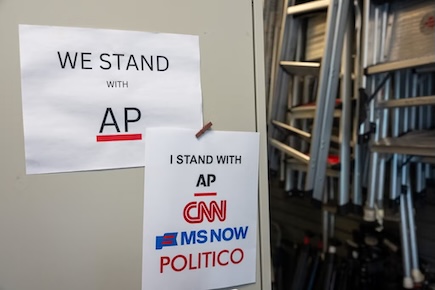
On Sept. 18, President Trump announced that news outlets CNN, MSNOW and Politico would be banned from the White House, initially accusing them of reporting “fake news,” and later saying their reports jeopardized national security. In response, the three outlets sued on Sept. 21, maintaining that revoking their credentials constituted First Amendment viewpoint discrimination and violated their Fifth Amendment due-process rights.
Less than a week later, Judge Timothy J. Kelly, a Trump appointee, issued a 14-day temporary restraining order requiring the White House to restore the journalists’ credentials, pending a final ruling in the case. Reporters subsequently regained White House access, although disputes continue over access to specific events. The three outlets have asked Judge Kelly for a longer preliminary injunction to keep the ban blocked while the lawsuit proceeds, which the judge is expected to consider in early October.
Between The Lines’ Scott Harris spoke with Victor Pickard, professor of media policy and political economy, University of Pennsylvania’s Annenberg School for Communication. Here, Pickard examines Donald Trump’s revocation of the three outlet’s White House press credentials in the context of dozens of previous Trump regime attacks on journalists, media outlets and the constitutionally guaranteed freedom of the press.
VICTOR PICKARD: This is just the latest in a slightly different type of attack on the press that we’ve come to expect from this administration. But this one was glaringly offensive for a number of reasons. One is that it just blatantly ran afoul of the First Amendment, freedom of the press in particular. And it is based on this posture that Trump takes. It’s almost dictatorial where he thinks he has this absolute power to dismiss the press if they displease him in some way. And really they do have a First Amendment right. I’m not an expert on constitutional law, but all the analyses that I’ve read convinced me that this will not hold up in court under First Amendment protections. But beyond that, this is how we keep our political elites accountable to the public. And even though so much of this White House-based journalism is what we often call access journalism, it is very performative and ritualistic.
It’s dependent on having access to these official sources, which is often a problem with our professional press. Nonetheless, it is a way that we are able as a society to communicate that politicians serve at our pleasure. They must be accountable to the public. And for Trump to summarily dismiss them was really a violation, not just the freedom of the press, but really of democratic society writ large. And the last thing I’ll say is that as much as we might prefer a different kind of journalism, obviously if we were given the choice, we would probably ask for more investigative reporting as opposed to this kind of just listening in on elites and hearing their oftentimes carefully manufactured sound bites. But every once in a while the journalists force them to speak off the cuff and we do occasionally get some new information on very important political matters, which of course during an election year is especially important.
So these are all a number of reasons and there are others why this latest move by Trump was so glaringly anti-democratic and it’s something that we have to oppose obviously.
SCOTT HARRIS: Victor, one bright side of this whole mess and violation of the First Amendment from Trump and his regime was that for the first time in both of Trump’s terms as president, we saw major corporate media outlets demonstrate some solidarity with their collective decision to boycott the White House press pool as long as CNN, MS Now and Politico were excluded. This is certainly a welcome development, but we have to ask why this little bit of courage took so long.
VICTOR PICKARD: It does seem in many ways too little, too late, but I agree with you that we have to celebrate the wins and the bright spots whenever we can. And I was pleasantly surprised, to be fair, to see that kind of solidarity. People have been calling for that for a long time. There was a press ban at the Pentagon. Trump routinely attacks individual journalists, often female journalists. So we’ve been waiting for a long time to see this kind of spine from the fourth estate where they do practice this kind of solidarity and hopefully we see more of it. I mean, if anything, I would hope that it emboldens them and makes them realize that when they do stick together, they really can be quite a force. I mean, there was that somewhat comical moment where Trump was trying to have a press event at the White House, but there was no television feed or there was no audio feed to capture what he was saying.
So he’s also being disciplined a bit here, sort of turning the tables on him to show that he relies on the press and the press has this kind of power and they really should operate, utilize it accordingly.
Listen to Scott Harris’ in-depth interview with Victor Pickard (27:01) and see more articles and opinion pieces in the related links section of this page. To subscribe to our podcasts, email newsletters, our Between The Lines Radio Newsmagazine Substack or social media, subscribe here.