Sarah Kendzior discusses her views on the Trump regime’s looming threat to subvert the outcome of the midterm election by a multi-pronged set of seditious tactics. She also comments on the enormous challenge of reconstructing our broken nation’s democratic institutions. Kendzior is the best-selling author of several books including her latest, They Knew and The Last American Road Trip.
SCOTT HARRIS: But I’m very happy to welcome our first guest and that’s Sarah Kendzior. She’s a journalist, anthropologist, researcher, and authority on the erosion of democratic institutions. She’s the best-selling author of They Knew: How a Culture of Conspiracy Keeps America Complacent; Dictatorship: It’s Easier Than You Think and The Last American Road Trip: A Memoir, her latest. Sarah is the former co-host of the popular political podcast Gaslit Nation and writes at Sarah Kendzior’s newsletter on Substack. Sarah, thanks so much for making time to talk with us this evening. Appreciate it.
SARAH KENDZIOR: Oh, thank you for having me.
SCOTT HARRIS: Sarah, many of our listeners, and I value your insights and perspectives on the many very ugly and depressing issues we face as a country. And here we are on Donald Trump’s 609th day. I got to look it up. I mean, it feels like 10 years, but back in the White House in a second term. Every single day, Trump and his administration roll out more alarming actions that directly attack democracy, free speech, the rule of law, the Constitution, Geneva conventions, ethics, human rights, while openly engaging in blatant in-your-face corruption. And I’ve got three pages of examples just from the last week. I won’t bore our audience who’ve probably been following all this. But with all of Trump’s authoritarian onslaught, it’s really easy to feel overwhelmed, tune out the news, or some people of course are accepting this badness as normal. I wonder what your thoughts are on where our nation is at right now, less than two months away from one of the most consequential elections in modern U.S. history that we’ll be talking about a little later, but how do you process what’s going on?
It’s really hard for me, and I know it is for many people.
SARAH KENDZIOR: Oh, sure. And I think when you said it feels like 10 years, it’s because it has been 10 years. We have had 10 years of Trump and the Biden interlude was really Trump and his backers continuing to operate behind the scenes because they were never punished even for open acts of sedition in January 2021. So this has just been nonstop kind of bad news for a decade. And then you add in things like AI technology, climate catastrophes, all of these other factors, which of course Trump and his administration are doing nothing to stop. They’re trying to exacerbate them and it is very overwhelming. I think there’s a big difference between expecting the worst and accepting it. I think it’s normal and rational to expect Trump and his backers to do the worst possible things for America, the worst things for ordinary average Americans. But that doesn’t mean you accept it.
It doesn’t mean that you kick back and sort of shrug and say, “Well, I accept this abuse of migrants. I accept this abandonment of the next generations and so forth.” You have to retain your moral core. And I wrote an essay about that a decade ago called, “We’re Heading into Dark Times” that gives advice about how to keep that moral core. And one thing I recommended people do is just keep a diary, write down every day what lines you wouldn’t cross, what values you maintain no matter what. And that way, even when you feel shook up and panicked, you still have a sense of who you are within this broader struggle.
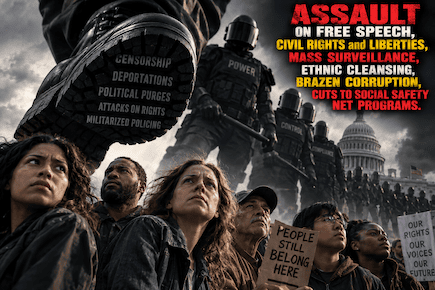
SCOTT HARRIS: Well said. And I want to get to the election because I’m sure like millions of people all across the country, we’re all deeply concerned about the midterm election coming up Nov. 3rd. And just to frame what we’re up against, Donald Trump’s overall strategy being employed to control the outcome of the election that will determine which party holds power in the House and Senate, it revolves around provably false claims of widespread election fraud. Specific methods include aggressive partisan racial gerrymandering; voter roll purges; imposing restrictive proof of citizenship; voter ID requirements that are onerous and will disenfranchise millions of people; closing polling locations; withholding federal funds to force states to turn over voter data; and change election procedures as well as targeting election officials for prosecution.
And some of the most alarming schemes, of course, that we’ve been talking about on this show for awhile. It’s openly discussed by the president and his sycophants in the White House: deploying ICE agents, Justice Department officials or the U.S. military to intimidate voters at key polling places or seizing ballots, voting machines. And there certainly is the threat to use the military to violently suppress peaceful protests in the event Trump and his buddy stage a coup. So I guess I’d like to ask you about complacency because I think, at least in my view, too many Democrats and democracy defenders from NGOs in Washington, they seem too complacent to me about the election. Being way too optimistic that everything will be all right, just vote early and make sure you’re registered. To me, I don’t know. If there is a coup backed by the military where 80 top officers have been either fired or forced to retire, you really don’t have any kind of checks and balances on the U.S. military anymore under Secretary of War Crimes Pete Hegseth, right?
SARAH KENDZIOR: Yeah.
SCOTT HARRIS: So we have a situation where I know I’ve been talking with Chris Hedges and he’s of the opinion that a general strike is really the only thing that can save us from a descent into fascism.
SARAH KENDZIOR: Yeah. I don’t know about the general strike and I’ll get into that more in a minute if you want to know why or why not I think that might or might not work. But yes, in terms of the complacency, yes. I mean, it’s as if people have selective amnesia. They don’t remember that Trump has already employed these tactics before. They’ve threatened poll workers. They’ve thrown out votes. They’ve threatened to murder people involved in tabulating votes. He threatened, I believe it was the governor of Georgia back in 2020, insisting that he had won the election. On tape, on the phone, what did the Democrats do in response when they had the house, the Senate, the presidency? Basically nothing. They did a reality TV version of hearings that enforced no actual accountability, didn’t pass any new laws to protect voting rights. They campaigned on the John Lewis Voting Rights Act and then failed to deploy it.
And all of those failures set in motion the position that we’re in now. And that’s why I was so insistent at the time that this needed to be done quickly. This needed to be done with the urgency that the situation merited instead of this whole kind of, “Oh, Biden needs to adjust and everything will be fine and it’ll somehow magically work out.” It won’t. These are paid Democratic consultants, highly paid consultants, and they’re paid to create this culture of complacency because they do not want protests. They do not want thinking citizens. They don’t necessarily want fascism. They don’t want the same things as Trump, but they are fine having this kind of status quo situation of kleptocracy as long as they’re part of the people who get paid by kleptocracy, by this mafia state rule of thieves. They’re willing to let the rest of us suffer.
As for a strike, the only thing I worry about there is that Trump from the very beginning, before he even ran for office, announced that his intent was to torpedo the U.S. economy. He went on Fox News in February 2014 and he said that we needed to destroy the economy, have riots, have police on the street, and then we’ll be great again. And so for him, if a lot of places go out of business, it won’t matter. If people can’t get basic supplies or food or functioning infrastructure, it doesn’t matter because the United States to him doesn’t matter as anything other than something to strip down and sell for parts. So while I like the idea of the strike as a way to kind of get people together and have a collective action, it needs to be so strategic. There needs to be a lot of backup plans of what to do if people can’t access basic goods and supplies, if electricity is cut off.
Remember when Reagan fired all the airline guys? I expect something like that, but on a massive scale, if there is a general strike against the Trump administration, he’ll just say, “Screw it. Screw regulations, screw survival, screw America,” because that’s just how he rolls.
SCOTT HARRIS: Yeah. I think one of the thinking behind a general strike is not really that Trump would suffer or be moved or pressured to do anything, but Wall Street might, right? If they see their profits going down the tubes, they may suddenly wake up and say, “Maybe this fascist thing isn’t quite on the menu or shouldn’t be on the menu.” I’m not sure these guys who are silent or complicit on Wall Street who are fine with their big tax cuts and not much worried about authoritarianism. I don’t know if they would come around as a result of a general strike that cuts into their bottom line. Not sure. What do you think?
SARAH KENDZIOR: They might. I mean, there’ve been some examples. I think Target had to change some strategies. I think McDonald’s did. I’m trying to think of recent examples. It’s just tough because I think that some of these companies are also under pressure. There’s this torpedoing of U.S. commercial culture. We’re seeing it today with the Paramount merger where they want to destroy a lot of things that America has done really well, like HBO or making high-quality TV shows, things America is known for abroad, things that generally people want, or the destruction of the Kennedy Center or whatever. There’s this sort of broader onslaught on archetypal things that hold us together as a nation. And a lot of these are silly commercial venues or whatnot, but at the same time, it gives a sense of coherency and the sense of coherency is what Trump wants to destroy. But yeah, I think a lot of people, especially at more mid-level corporations, not something like Amazon or Tesla or some sort of mega corporation that’s clearly in the same mafia cohort as Trump and the rest of the government, but kind of more regular folks that are still functioning at a level far above from near you in terms of monetary wealth, they might be secretly very freaked out by a lot of this because people crave stability.
They want predictable results. They don’t want to repeat 2020 or 2008 or all these other giant economic crashes. And I think a lot of them see one of those on the horizon and know that in this case, their likelihood of a bailout of some kind or help of some kind is going to be dependent on their spoken loyalty to this government because that is how Trump has operated the entire time he’s been in office, both terms. It’ll mean doing things differently, losing their own ability to make decisions, their own sovereignty in a certain sense. And so I think that makes people wary. I think there is a kind of quiet rage in the background that perhaps people are afraid to express at this point.
SCOTT HARRIS: Indeed. We’re speaking with Sarah Kenzior, a journalist, anthropologist, researcher, and authority on the erosion of democratic institutions. She’s the best-selling author of several books, including her latest titled The Last American Road Trip: A Memoir. Sarah, if they take control, if the Democrats take control of the House or the Senate or both, they face an enormous challenge of reconstructing our broken nation’s democratic institutions. They probably won’t get a chance to really do that until they have a trifecta, the House, Senate and the White House, maybe the following year in 2028. But as you said before, Democrats aren’t very good at accountability. We’ve seen failure after failure with George W. Bush. There was never any Democratic party effort for accountability about mass surveillance or torture. And in the case of Donald Trump, as you said earlier, Merrick Garland, the attorney general under Barack Obama—or I’m sorry, under Joe Biden—he waited two-and-a-half years to prosecute Trump after the Jan. 6th insurrection that killed a bunch of people, and of course, was a blatant attempt to overthrow the elected U.S. government.
So Democrats back in power in Congress, what do you think?
SARAH KENDZIOR: I mean, I think a lot of them are in on it. Not most of the Democrats, but definitely the top ones. I think Pelosi was when she was heading the house and now Jeffries is, that he is her heir, her successor. I think Chuck Schumer is somebody who has long served to help the Republican party. I think they’re in hock to their donors, in particular AIPAC, Silicon Valley donors, fossil fuel donors. A lot of them overlap directly with the Republicans. You have the same lobbying groups and the same corporations paying off everybody on both sides of the aisle so that there isn’t any true representation. And again, it’s like people forget the Democrats did actually win in 2020 and they got the House, the Senate and the presidency, and then they failed to enact even their most basic campaign promises. I mean, one I’ll never forget, it’s just that they resolved to protect the Postal Service.
That was a major issue because Louis DeJoy had tried to tamper with the election. And then when Biden replaced people on the board of governors that selects who’s in charge of the postal service, he picked people that would protect DeJoy. So this whole situation we’re having now with mail-in ballots and the legitimacy of the election and whether Trump is going to start to claim that votes are illegitimate because of it, all could have been prevented had Biden just fulfilled his campaign promise on the most basic thing, like the Postal Service. Everyone likes the Postal Service. Nobody’s out there like, “Yeah, they’re monsters. Let’s get rid of them.” It’s one of the few institutions that basically everyone agrees is great, that and the national park system, which of course Trump is also trying to destroy.
But they didn’t do it. They had two years to get this stuff done and they failed. I think that because the Republicans are so overtly horrible, there is a good chance that Democrats will win, including in places they haven’t won in a long time. But that shouldn’t really be seen as an endorsement of the Democrats as much as just real fear and hatred of the Republicans because they don’t follow through. They have this constant rotating villain that just switches sides. It was like Joe Lieberman when I was younger, so Connecticut shout-out there. Now it’s John Fetterman, it was Kristen Sinema. There’s always one who just switches and then you end up with a 51-49 vote and it doesn’t pass and it’s a mess. And so I wonder who that person will be. It’s very frustrating. I sometimes think the greatest success will be more in governors or mayors or people who can issue direct orders and get direct results like the way (Zohran) Mamdani has been doing in New York.
And obviously he has his flaws too, but it seems like he moves at a much faster pace without a lot of this nonsense that the Biden folks especially did. Remember the Senate parliamentarian? Suddenly all these characters come out of the woodwork whenever anyone has a good idea and they’re like, “No, no, no, no, no. Impossible. That can never happen.” And then everybody’s like, “What did I vote for? Why did I spend all this time?” I’ve heard this from volunteers, “Why did I spend all this time volunteering to campaign for people and help them for free when they are no desire to help me and they’re doing nothing to stand up to all this red tape and bureaucracy either?”
SCOTT HARRIS: Yeah, it’s no wonder people are cynical and think, “Hey, nothing’s ever going to change and there’s got to be a movement that changes that or we’re headed to hell.” I think we’re convinced of that.
SARAH KENDZIOR: I think we’re in it. So it’s kind of like “honestly getting the lay of the land in hell” is kind of an advantage I think for future planning. It’s not very much fun when you’re in it, but yeah.
SCOTT HARRIS: So Sarah, of course, you have a lot of thoughts about the failures of our media system and the news was just yesterday, I guess, that Trump has banned CNN, MSNow and Politico from the White House. These outlets are justifiably angry, upset. It is an assault on the First Amendment. And in that context, we have MAGA oligarchs takeover of many other media outlets. You’ve got Elon Musk and the Ellisons, CBS—the stalwart news network of Walter Cronkite is turned to the dark side. So we’ve got a real horrible, in my view, media system. But even before these takeovers, even before the direct assaults on the First Amendment, our media system was really good at reading headlines, but they really investigated the origins of Trump and the Republican party’s embrace of white supremacy and authoritarianism. And of course, you actually have pointed that out, that there is a lot of context that people need to understand where Trump came from.
He just didn’t come out of the blue. So I wondered if you would talk about the need for a media system, and I guess here we are an independent media where we’re able to say some of these things where the big outlets can’t or won’t. Yeah, address that if you would, in terms of the deeper story here that needs to be told.
SARAH KENDZIOR: Yeah. I mean, when I heard today about the banning of CNN and MSNBC and so forth, I mean, obviously it is wrong. It’s an autocratic move against free speech, free media, etc. But I also thought, where will I get my lack of news? Because none of these outlets have been telling the truth about Trump, his financial backers, his ties to organized crime, his ties to illicit foreign actions. For over 10 years beforehand, before he was a political figure, a lot of really horrific things about Trump and his cohort were uncovered. And the reason I was able to write books about them is because the information was in the public domain, written by people like David K. Johnson or Wayne Barrett or other reporters from the ’80s and ’90s where Trump was a well-known figure associated with crime and grift and fraud. And then again, it’s like this selective amnesia.
It went out the window. Jeff Zucker, who headed CNN in 2016, had a framed Trump tweet on his wall and Les Moonves at CBS said that Trump is bad for America, but great for CBS. They completely brought this upon themselves. And so that doesn’t leave us Americans who need information in a better position at all, but they failed. The media failed us too, just like the Democrats did. And then I think it’s even worse when you’re kind of getting into these giant corporate mergers, the loss of entertainment, the loss of imagination, because you see this broader motive to have everything replaced by AI, to have articles generated by AI, entertainment generated by AI. They want to get rid of individuality. They want to get rid of creativity because those are real threats to autocratic governance.
On the flip side, we’ve had the growth of the Internet over the last 30 years. It’s produced tons and tons of independent media that I couldn’t have dreamt of when I was a little kid, including my own writing. So we do have these platforms and this ability to speak for ourselves, but it’s shrinking. When Musk brought Twitter, he brought the ability to end a lot of group organizing, to turn surveillance on people who had used that platform to do political activity, all sorts of stuff. And our ability to speak freely is shrinking. People also increasingly paywall their work, making it unavailable to the general public, which is why I think many people are just not informed on Trump’s broader background, his criminal background, or they forget. They forget all this stuff from the first Trump term when he was impeached twice when there was the Mueller probe. There were all these things that happened that I think honestly have kind of slipped folks’ minds because things are so much worse now that they forget the precursor era.
But it’s important to know all that. So I think what all the journalists who now, they had relied on access journalism and so forth, they should just spend this time at the library. They should just go get library cards and go read all these books about Trump. There are many from the first term, especially from before, go through the new superarchive and learn about the person that they’ve been supposed to cover for the last decade and who they’ve actually been covering up for. It’s time for them to stop being propagandist. It does not pay off. It does not benefit them or us and tell the truth. And there’s a wealth of information out there. It just needs to be synthesized, analyzed and put together.
SCOTT HARRIS: Thank you for that, Sarah. A lot of our journalists in mainstream should spend some days reading your books. That would be a great benefit to all of us. Just a final question. I wanted to follow up on what you were saying about Elon Musk and the threat of artificial intelligence. We have a group of technofascist billionaires who are aggressively attacking and undermining democracy. And there’s a book that I know you’re aware of, Nerd Reich, written by Gil Duran, that really paints a completely alarming picture of the ideology, the fascist ideology of these tech billionaires that stand to be trillionaires before not too long unless this AI bubble bursts, right? And they will have such enormous power. They already have enormous power and they’ll even have more. And they are aggressively in opposition to democracy, we’ll put it that way. And I’m wondering what your concern is with regard to AI coupled with these technofascists who have no belief in democracy and want a corporatocracy that they design themselves.
SARAH KENDZIOR: Yeah. I think they’re a phenomenal threat. I think they’re a greater threat than Trump. Trump will go away at some point. In some senses, Trump is old school. This is an old school mafia state kleptocracy, 20th century kind of guy. What the techno-fascists want is really alarming because we already have digital dependency. We already have so many things that rely on us carrying a cell phone with us. The analog infrastructure we used to have, things like payphones, for example, are gone. And there’s this expectation that we bring what are essentially little surveillance devices with us in our pockets. And I use as little as I can. I download as few apps as I can, but a lot of people are tracking themselves, tracking everything they do and then not realizing that that data gets sent to these very anti-democracy pro-surveillance dystopian tech lords and their company.
And I think their goal is to create something kind of akin to the social credit system in China where basic actions you might take, like applying for jobs, using public transportation, whatever, will be linked to what we do on social media. And because social media, it’s inescapable even when you want to escape it. I make my living off of a newsletter, so I’m in this position. They want to control what we’re saying on there and who we interact with and what we’re allowed to talk about and what information can be free. They want total control over that and that’s scary on so many levels. It’s scary for the individual who could be punished. They’re building all these private prisons for a reason.
But it’s also just something that has such a horrific effect on society as a whole that just sucks the soul and the spirit out of everyday living. It makes it very difficult. It’s not hopeless, but right now I encourage people to figure out ways to kind of wean themselves off of digital dependency. The Internet can do a lot of great things. Use it for the things that are good, but don’t track everything you do and don’t rely on it for everything. Remember how to use a map again. Remember how to use all the tools you used in the ’90s before this came along and show your kids and get them to be self-sufficient because the less these folks know about your day-to-day life, the better. And some of us have more freedom over that amount of information we give them than others. And if you can get that freedom, I say go for it.
Don’t shut yourself off completely, but relearn those skills.
SCOTT HARRIS: Excellent advice. Well, there’s so much more to talk about, Sarah, and really appreciate your analysis of the state of our democracy and our nation right now. When we hear a commentary like yours in the analysis, we don’t feel so alone. So appreciate you being here tonight. And yeah, we’ll look forward to our next conversation maybe with some more hope as one ingredient that we can talk about.
SARAH KENDZIOR: I’ll try my best.
SCOTT HARRIS: All right. Thanks so much, Sarah. Oh, leave us with the website where our listeners can find your writing on the Substack.
SARAH KENDZIOR: Sure. Yeah, just sarahkendzior.substack.com. Kendzior is K-E-N-D-Z-I-O-R.
SCOTT HARRIS: Got it. Thanks again, Sarah. Appreciate all you do.
SARAH KENDZIOR: Thank you.
SCOTT HARRIS: Bye-bye.
SARAH KENDZIOR: All right. Thank you. Bye.
SCOTT HARRIS: That’s Sarah Kendzior, and she’s a journalist, anthropologist, researcher, and bestselling author.