
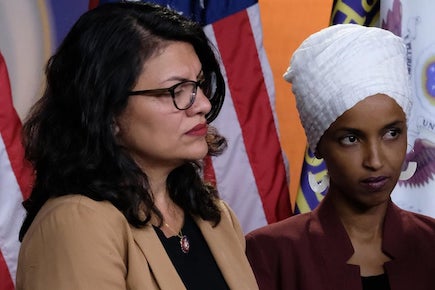
After initially granting permission for two U.S. congresswomen, Reps. Rashida Tlaib of Michigan and Ilhan Omar of Minnesota, to travel to Israel, the government of Prime Minister Benjamin Netanyahu reversed itself and blocked the two Muslim lawmakers from visiting the Israeli-occupied Palestinian West Bank for a fact-finding mission. Israel’s imposition of a travel ban on the two outspoken critics of Israel came soon after Trump’s tweet which implied Israel “would show great weakness” if it allowed the two lawmakers to visit.
Israel’s decision to block travel by U.S. legislators at the behest of an American president is unprecedented and Israel received scorching bipartisan criticism, even from longtime allies such as AIPAC, the staunchly pro-Israel lobby group. Israel responded by granting Rep. Tlaib permission to visit her 90-year-old grandmother in the West Bank if she agreed not to promote the Boycott, Divestment and Sanctions, or BDS movement while in the country. Initially, Tlaib accepted, but later rejected the offer, renouncing the oppressive conditions set.
Between The Lines’ Scott Harris spoke with Phyllis Bennis, director of the New Internationalism Project at the Institute for Policy Studies. Here, she discusses Trump’s role in Israel’s decision to block the two congresswomen’s travel, Israel’s view that the BDS movement is linked with a terrorist security threat and the current human rights conditions for Palestinians that the lawmakers had planned to investigate.
PHYLLIS BENNIS: Trump did admit later that he had talked to some people over there. He didn’t specify that it was Netanyahu, but it was pretty clearly including either Netanyahu personally or people very close to him. And then he sent this public tweet saying that if Israel allowed the two congresswomen in, it would look like Israel was very weak. It would make Israel look weak. And that was his message to Netanyahu, who immediately said, “oh, we’re not going to let them in. And oh, by the way, we have a law that says we don’t have to let in anybody who supports the boycott, divestment and sanctions movement,” which uses nonviolent political and economic pressure on Israel to try and get it to end its violations of international law. And, he’s right about that. Two years ago, the Israeli Knesset did pass a law that says that Israel has the right to reject the entry of anyone who supports BDS.
Of course, that’s used not consistently. It’s used when it’s useful. And in this case, it was used against the two congresswomen. Now, the significance of it was kind of on three different levels. At the immediate level, the notion of a U.S. president calling on a foreign leader to deny access to their country of elected members of the U.S. Congress was absolutely unprecedented. Absolutely unprecedented. Number two, this is something that was not the first time Israel has denied people entry. Of course, you need to go through Israeli checkpoints, whether it’s the airport or the bridge over the Jordan River to enter the Israeli-occupied West Bank or Gaza Strip. Unless you go in from Egypt, which almost never happens into Gaza. But for the West Bank, you have to go through Israeli control. So Israel controls who can and cannot get into the Palestinian territory. So even if somebody said, “I don’t want to go to Israel, I only want to go to the West Bank,” there is no way to do that without going through Israeli-controlled entryways.
So in that sense, what Israel did to Rashida Tlaib and Ilhan Omar happens everyday – everyday, everyday to Palestinians, to Palestinian rights activists, to people who might be perceived to be Palestinian rights activists, even if they’re not and get held accountable. So the denial of entrance is a constant threat. So, the kind of humiliation, the kind of expression of power is a constant in the lives of Palestinians. The third thing is the more long-term question, and that is the degree to which this alliance between Israel and the U.S., this partnership between Netanyahu and Trump is situated in the midst of a rising right-wing – what we might call an axis of authoritarianism. You know, this is a set of ethnopopulists and dictators around the world who are looking to Trump for support for enabling – sometimes for money, for arms, for arms sales. So you have governments from Brazil with Bolsonaro calling for killing people in the street to Duterte in the Philippines who is killing people in the streets – the roundup of journalists in Turkey, the role of absolute monarchs in Saudi Arabia and the UAE. All of these things are happening in the context of the rise of Trump as someone who is providing political support, diplomatic protection, armed sales, denial of the importance of human rights – all these things that is enabling the consolidation of power by these very right-wing forces all around the world.
BETWEEN THE LINES: Phyllis, long before this media coverage of Israel’s decision to impose this travel ban on these two congresswomen, Israel in creating their law that allows them to ban the travel of people who support BDS – boycott, divestment and sanctions – has equated BDS with terrorism. And I heard that over and over again this past week where Israeli officials were basically claiming that advocates and supporters of BDS are in fact doing the bidding of terrorists and are in league with terrorism.
PHYLLIS BENNIS: Yeah, I didn’t hear as much of the equation of BDS with terrorism. BDS is generally condemned by Israeli officials as being designed to delegitimize Israel and to deny the right of Israel to exist, that it opposes a two-state solution, et cetera, et cetera. None of which of course is true. I mean, if people had read the actual statement of the BDS movement, it’s very clear. It speaks to three specific violations of international law. Those being the occupation of the West Bank, Gaza and east Jerusalem. The denial of equal rights to Palestinian citizens of Israel who maintain citizenship. They can get a passport, they have the right to vote, but because a lot of rights in the Israeli system are based on nationality rather than citizenship, their citizenship rights are second, third, or fourth class. And then thirdly, the denial of the right of return of Palestinian refugees. So all three of those are direct violations of international law and human rights, of course. And BDS basically says, we will use boycotts and divestment campaigns and sanctions to pressure Israel to end those violations. That very clearly does not take a position on states. It’s about rights. It’s not about states. So it’s a complete fabrication that it’s a denial of one or another position on states. It’s also a fabrication to link it to anything other than nonviolent actions.
For more information, visit the Institute for Policy Studies at ips-dc.org and the IPS New Internationalism Project at ips-dc.org/new-internationalism.


